 |
PLANETS
All
theories about the development of the |
|
PLANETS
All
theories about the development of the |
|
In this chapter,
we will develop a new idea
|
 |
 |
 |
 |
 |
  |
|
This inertia is of course proportional to the content of the impulses of the bodies, i.e. its “amount of atoms” and the “kind of atoms” determine its resistance - from the force which overcomes this we calculate the “mass“ - and from the mass the force. And we know that basically neither of the two exists. After all there are only the impulses... And what is happening through them is just the sum of all impulses involved - we are thus not dealing with forces at all but only with impulses. For that reason, the physicist does not speak of conserving the force but of conserving the impulse. This is demonstrated in the best fashion by the spheres transmitting an impulse (fig. 89a). |
|
|
|
|
|
We all know these impulse spheres; the most astonishing with them is the fact that the number of spheres swaying away always corresponds exactly to the number of spheres that were shoved. The process, however, is easy to comprehend if one realises that a quantity of impulses (“mass“) which is supplied at one end of the device has to get out again at the other end after it has “pulsed” through the spheres. Two spheres correspond to a certain field size which is transmitted through the atoms - and this certain field size just corresponds to two spheres again at the other end. Amazing that such a dynamic process requires the absolute matrix of T.A.O. as prerequisite - but without this matrix the spheres would not exist - and their motions least of all. Well, a billiard ball does not just roll along either but its internal vibrational image only corresponds to this motion2. It is transmitted through the matrix and it transfers its impulses to the “next“ billiard ball. And when we make it only rotate, again we see nothing but the process which we found with the straight-lined movement - its internal impulse image corresponds to the initiated rotational moment (or is “storing” it) and it continues rotating infinitely... And then that is just the “conservation of the angular impulse“! As we will see in a minute the occupation with this angular impulse is not only lots of fun but it is also particularly important for understanding the motion of celestial bodies. And since we want to concern ourselves with celestial bodies and planets we take this little digression upon ourselves now. Rotation is also a motion which could only be changed by applying force. In the ideal case, the axes of a gyroscope stay where they are for that reason - they are fixed in space. That is no particular wonder anymore after all we know. And now let’s watch a ballet dancer for a moment and how he is doing pirouettes... |
|
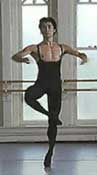 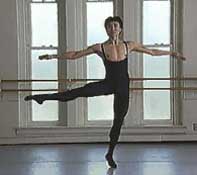 Fig.
89 c Fig.
89 c |
|
|
What we can observe is something very strange: when the dancer extends his arms during the rotation he turns more slowly ... but when he draws his arms in, his rotation becomes suddenly faster. When disturbing forces (friction etc.) would be eliminated, he could play his little game endlessly and regulate his rotational frequency simply by extending his arms or legs. Yes, this extending would even have a fixed connection with his velocity! If we ask a physicist why this is exactly so, he will say: “Due to the conservation of the angular impulse!“ “And why is this angular impulse so keen on conservation?“ we could ask and would be told: “I don’t know, this is a law of nature!“ |
|
|
|
Let’s assume we made a field, i.e. a body, rotate. We inflicted a modification upon its internal impulse oscillations which corresponds to this acceleration. So to speak we introduced another “image” - precisely the image of a rotation. For the body, this is a new “normal state“ - it retains the internal image and what we perceive is a rotating “object”. What we actually perceive is a field which is composed of impulses on certain specific paths. These impulses have an ultimate propagation velocity (c !). The result or the sum of all these impulses and their inner directions result in a definite rotation and speed of rotation. When this field is getting bigger (ballet dancer extending his arms), the impulses take a different direction. They can only do that at maximum at the velocity of light because the structure of the T.A.O. matrix determines it this way (“distance between the dominos“). For that reason, the velocity of rotation is loosing this amount since - as long as the enlargement of the field takes place - the impulses of the field are moving outwards just a little. The new velocity of rotation (angular velocity) is the result of the radial and tangential components of motion. This is of course (only apparently!) slower than before. The whole process, however, will not work in this way unless there is some restriction to the speed of (light) propagation by the T.A.O. matrix! We thus see with amazement that the velocity of light (again!) plays a role in the conservation of the angular impulse. When the ballet dancer retracts his arms the process takes place the other way round. The impulses of the field twist their direction round during the alteration, the resulting angular velocity of the total field is getting higher. The impulse or energy content of the total field remains always the same regardless of any change in size – and still the velocity of rotation changes! Again the velocity of light is to “blame” for this phenomenon. If the atomic impulses could go beyond or drop below this velocity of propagation, they would adapt to the modification - and the body would not change on the outside and maintain its angular velocity! |
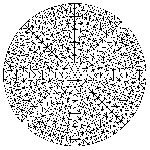 Fig.89
d Fig.89
d |
|
|
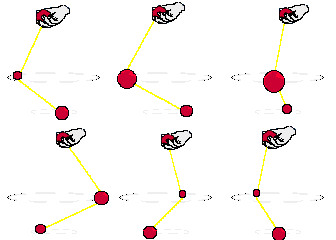
Figure 89 d tries to support our imagination a little. The various directions of the impulses are symbolised by the lattice. Enlargements or reductions of the field will change the direction of the lattice components to the outside or to the inside - as shown by the small diagonals. The paths of the impulse change correspond-ingly and can always only be passed through at c. Who does not think of Einstein when he hears the word velocity of light? Who of the “insiders“ does not already suspect that this causal existence of “c“ in the phenomena impulse, conservation of impulse, conservation of angular impulse, inertia, and gravitation could have something to do with the General Theory of Relativity? He suspects correctly - but we are not yet at that stage by far! Because the next thing we will examine is what the whole business of angular impulses has to do with Kepler's laws. Well, some facts have to be noted down in particular. The rotational velocity is proportional to changes of the radius. The ballet dancer extends his hands and his rotation slows down. But within one unit of time his arms are passing over the same area as before ... and when he retracts his hands he rotates faster, though, but the area covered per unit of time is again the same. When we follow one point of a rotating body and measure the area which the radius covers within a second this area will always remain the same even if we vary the size of the body – only the velocity will change accordingly. A stone tied to a string and spun in a circle is getting faster when we reduce the length of the string while doing so – but the area which the string passes over within one unit of time always remains the same! That has to be expected for we did not change anything in the energy-impulse content (“mass“) of the stone, of course. This connection of the velocity with the radius and with the area covered is called the “law of areas“. And we will learn on the following pages that we already described Kepler’s second law with that... When we tie two spheres together and make them rotate, we see how they appear to revolve around a mutual centre of gravity in reverse motion. In fact, the movements of the two spheres “depend on” each other in the sense of the word - but in truth there is no centre of gravity. And now we will examine why the sun plays a very similar game with its planets.
|
|
|
|
|
Menu |
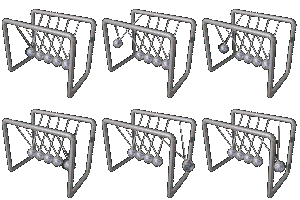 Fig.89
a
Fig.89
a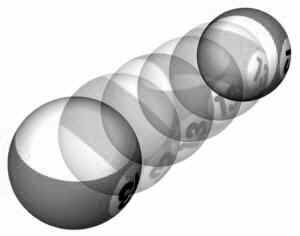 Fig.89
b
Fig.89
b