|
What we know so far is fundamental for understanding this chapter: the matrix of T.A.O. is absolute and immobile. It transmits impulses through vibration or fluctuation of its units (“granules“). It can be concluded only from the absoluteness of the matrix that these impulses stay together (!) and transmit information (energy, light, force, etc.); one of many manifestations of these impulses is the EM wave, another manifestation (coming into existence secondarily) is the “polarised space” as electric and magnetic field. In principle, these polarisations accompany all electromagnetic phenomena. The material manifestation of the impulses is the atomic field, an area of rotating impulses, point of origin of a field in which electric and magnetic field are latently contained, a field which is essentially unlimited and adopts its material dimension only through resistance towards other fields and whose unpolarised (“straight, neutral”) shoves, however, form the field of repulsion (“neutrinos, gravitons“) which is in penetration and in touch with other (in principle with all) fields of repulsion of the
universe.
An atom moving within T.A.O. makes use of the matrix, i.e. its impulses propagate within the matrix in the same way as an EM wave. In other words: the atom transmits itself, it induces itself and thus pulsates through the matrix - it does not move like a compact object (because this would not work at all: how should freely oscillating impulses stay together and how should the atom move without the impulse-maintaining and field-stabilising structure of the matrix?). For that reason, there isn’t any “real“ or direct material movement2 of atoms or atomic conglomerates within the matrix - and thus within the
universe.
This way of looking at things is absolutely astonishing, and we will see what a far-reaching effect it will have. In view of such a multitude of movements within our world our imagination refuses to accept the image that bodies are oscillating through space in a somehow shadowy way - but we already know enough about this “nothingness” of energy, space, and time which we call “mass” to admit such an image – because even according to conventional theories matter consists almost only of gaps! But atoms cannot just simply “shift“ their oscillational image autonomously - but they have to direct these vibrations through the matrix. This is absolutely plausible and logical. We are as little aware of it as of the oscillating atomic fields themselves - because our perception takes place on a scale high above it - but we will be talking about that
later-on.
Now let’s imagine a three-dimensional picture of such a field of repulsion: the field around a body consists of the same impulses which also form the magnetic field - but they are not polarised. The particle physicist would fantasise about neutrinos which were spherically flowing away from the body - and that wouldn’t be so far off the truth at all. And one could even postulate gravitons, with the difference that they don’t convey an attractive force but a repulsive one. After all, the oscillations which have a repulsive effect within T.A.O. constitute the field. Just think of the streams of particles and the solar winds flowing away from our central star. Now let’s picture this in a more refined, more delicate, more “transparent“ way and we will have a much clearer impression of the
situation.
The field develops from the continuation of the atomic impulse fields; the energies and dimensions are extremely small and cannot be measured - but exactly this is the reason why they penetrate other fields without any effort- we know after all that gravitational fields, just like magnetic fields, can scarcely be shielded - and therefore we also know that magnetic fields have to be a manifestation of the gravitational field. Inside the universe a total field consists therefore of the sum of all the repulsion from the surrounding “masses” - this results in a certain state of tension (pressure is not the correct word) which disperses the bodies (expansion of space!). In order to surround a body which is getting into this field of tension, with a gravitational field nothing has to happen in particular because the repulsive pressure of the universe streaming in from all around partially penetrates the body and re-emerges weakened on the other side - there it sums up with the individual pressure of the body and is directed against itself. But let’s take a look at it on the graph.
As simple as the whole matter is, it is no very easy to depict it graphically... Concerning the two attempts at a graph (fig. 73 a and b): The vectors streaming in from the cosmos are weakened when they re-emerge from the body, they also symbolise the individual pressure of the body which is, however, very low. The body brought into the field of the universal pressure “shadows” the field so to speak and is partially penetrated - therefore it seems obvious to attribute the effect of gravitation not to the mass but to the density of the body. Actually these are the facts which really apply. Here is a corresponding thought experiment.
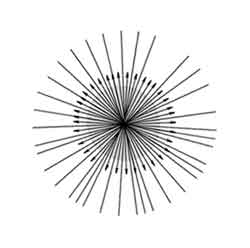 Fig.73 a Fig.73 a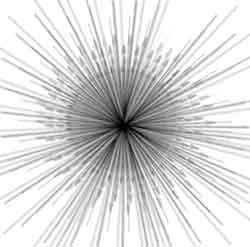 Fig.73b Fig.73b
If we drilled a hole straight through the globe and threw a stone through it, it would take the stone 42 minutes to cross the globe and then it would return in pendulum fashion. It would take the stone the same time to cover the distance there and back as for orbiting the earth in a narrow circle once - about 84 minutes. If we did the same in the asteroid belt with a fist-sized asteroid and a grain of sand, we would obtain the same result provided that the asteroid would have the same density (!) as the Earth’s globe (5.5 g/cm³)! This proves that it is the density of the body and not its mass as such which plays a role in gravitation and in the acceleration of free fall.
And with these preparatory considerations we will take a closer look at the whole matter: Galileo discovered that a uniform motion in a straight line does not require a cause but “continues out of itself”. He postulated: a body left to its own devices moves in a straight-lined and uniform manner. This theorem is called Galilean Principle of Inertia. We read in many books on physics that this profound insight was the beginning of modern exact natural science. This is a strange claim because Galileo’s observation does not explain anything but describes only an effect which everybody can
observe.
If we ignore that straight-lined is a very relative concept because we know that already the structure of space can curve, Galileo’s consideration is without any doubt true. But which cause is behind this principle of
inertia?
Every body shows a certain ability of offering resistance to an acceleration. Newton expressed the extent of this ability by means of the inert mass. This fiction was just as magnificent as it was teleological because in principle it does not explain anything,
either!
The physicists Mach and Hoyle and even Einstein had the vague idea that the cause of inertia had to be found outside of the corresponding body somehow. In fact, it looked as though something was offering resistance to the motion of a body - as though the body was moving within a medium. This is partially true for that reason that the matrix of T.A.O. is formed by and pulsed through by the surrounding mass fields. But the inertia doesn’t have its cause only outside of the
body!
Our figure 15 shows already very clearly how the field of a body exerts an individual pressure directed against the environmental pressure of other fields (universal pressure). All protons or atoms as individual fields sum up this one body to a total field which resembles the individual fields in its effect and represents just a bigger, practically infinitely expanding field (figure 74a).
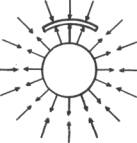 Fig.15 Fig.15 Fig.74a
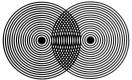 Fig.74b
 Fig.74c
Figure 74b is to make clear how the fields penetrate each other as far as their motional state allows. Repulsion develops as if one squeezes rubber balls into one another. This repulsion has directions, it is directed against the antagonising fields – and this is the difference between the repulsion principle and the previously known pressure-gravitation theories. This difference is important because all the previous theories proceeded from the assumption of a pressure stemming from some invented particles (gravitons) (fig. 74c) which hover between the bodies. This entails the problem that this pressure is constant and that the particles between the bodies have to disappear somehow in order to offer those outside the possibility to press the bodies towards each other. There are some bizarre explanations for it, like streams of particles and absorption theories, which we don’t have to deal with because they are illogical and couldn’t even explain why there is something like a “centre of gravity”.
Instead we will deal with a “flawless” field theory. The boundaries of matter are not where we perceive or see them. Every object that we touch has been in contact with us - with our field - long since. All matter - even celestial bodies - practically penetrates each other with its expansive fields. The difference between the object and the empty space is defined by very specific energy values. Our finger becomes a finger and the object it touches becomes an object in the very place where the two fields offer each other sufficient resistance. Our senses prepared themselves to put a boundary in this place so to say. Yet, the fields reach far beyond these boundaries and indirectly they can even be made visible by some kind of high-frequency photography. We know this phenomenon from books about parapsychology - but it is an absolutely normal process. In the same way as we can render the ultrasonic screams of a bat audible by creating differential tones in our frequency range of hearing by superimposing other ultrasonic frequencies (this also works excellently with dolphins), we can, at least partially, relativise the visibility boundaries of a field by bringing them into the range of visibility by means of superimposing a high-frequency electric field. This method is called electrography or Kirlian photography . Bodies particularly rich in energy, like organisms or the poles of a battery, show a very distinctive, clearly visible field which certainly also reveals every energetic change in the body. A leaf portrayed with this method shows how its field is streaming off boundlessly into the environment (figure 75).
 Fig.75 Fig.75
 Fig.76 Fig.76
The field of a compass needle touches the field of a leaf before the visible boundaries come in contact with each other (figure 76). Individual fields sum up to a total field like the three leaves in figure 77 demonstrate.
 Fig.77
A horseshoe magnet shows the polarised space by which it is surrounded in a particularly impressively manner (figure 78).
 Fig.78 Fig.78
The field differs succinctly from the fields of organic structures - we literally see that it has to be stronger and more
orderly.
In principle every atom, every object, every body, and every star has this field around it. It is just the continuation of its Self beyond the range of the physiologically visible and has nothing to do with such mysterious concepts as Aura or Od. These names – which have been used for the detected fields of force of matter by parapsycholo-gists for a long time - have dubious overtones because the scientists have persistently refused to examine and interpret these phenomena. Little wonder because their theories did neither predict them nor did they allow for an
explanation.
If we remember our fan wheel we understand immediately that mass is equivalent to the energy content (the motional state) of a field. According to Newton, mass is defined by the inertia of a body. The following tempting thought would appear to be the right thing: this inertia is nothing else but the resistance which the adversaries universal pressure and individual pressure (or rather the reduced universal pressure passing through) find with each
other.
In a motionless state, every body is in equilibrium with the universal pressure. Well, let’s just push it out of this equilibrium (figure 79).
 Fig.79 Fig.79
We could simply say that the resistance increases in the direction of the motion. We would have to exert a force to move the body out of its resting position against this resistance. Opposite to the motional direction, however - i.e. “behind” the body – the resistance is reduced because a “hole”, a reduction of the pressure, arises in the universal pressure so to speak. Metaphorically speaking: in front of the body something could “accumulate”, behind it something could thin. What could that be? The matrix of T.A.O.? But it does not move. It cannot be squeezed together or thinned! Therefore our explanation is obviously wrong. And now we know why Mach, Hoyle, and Einstein did not pursue the thought of a surrounding gravitational cause any further (which was an omission but the medium, “ether“, which was up for discussion at that time did not support this
idea).
When we apply a force upon a body, for example by pushing it with one hand, it means that the fields of our hand meets with resistance at the fields of the body - and that the impulses of the atoms at the boundary of the body are influenced by it first. They retreat. And we know of course that the body does not move compactly but that its individual atoms propagate through the matrix... The atoms pass on the modifications to the impulses - thus the body moves at “intervals”, i.e. it propagates… And this explains some very essential things: firstly: the exerted force propagates through the body - it does not act instantaneously onto the body. One atom shoves the other... and that means also that the body does not move at all on both ends at the same time - because the force is passed on with a finite velocity: we know this velocity already: it is the velocity of light! Secondly: all atoms of this body are (roughly speaking) gyroscopes after all - with rotation or spin. Therefore they cannot be shoved into new impulse sequences and impulse spaces just like that but they put up resistance. They will do it as long as we apply the force - i.e. accelerate. And that is already the solution to the mystery of inertia! Thirdly: when the body does not move compactly at all and a force marches from one end to the other (in direction of the movement) and presses against one impulse field after the other, the body gets a little bit shorter in the direction of the movement. The physicist Lorentz would be glad now because that is exactly what he had suspected after all (and Einstein would also smile a little but we are going to cure him of it)! But that’s for later to be seen. When we don’t exert any more force the atoms don’t change any further, either. They go on drawing their circles... and nothing else happens ... Once levelled out, the body just continues to propagate... It is not only about the atoms being something like gyroscopes (which they are really not) but also about every change of direction costing the impulse some energy... and about the direction of the impulse paths within the matrix being changed when we set a body in motion. He who thinks of the Lorentz force already mentioned in the chapter “Games“ is not so
wrong!
With the knowledge of the internal relationships we can describe the events a bit more superficially again. The resistance created by inertia retroacts like a resilient medium. We had to exert a force in a certain direction and with that we enriched the field of the body by the contributed amount of energy. This energy is now contained in the body - and we call it kinetic energy. Exerting a force on a body is in addition a symmetrical process (as we will see more clearly with gravitation). It is not one field touching the other but it’s always two fields touching one another! That means the exerted force is always perceptible for both sides. This is nothing else but Newton’s third law of motion which says: principle of action and reaction - every body on which a force is exerted experiences a force of the same magnitude in the opposite direction... The sum of these forces is always zero. This demonstrates immediately that there is just no difference between motion and rest. So to speak, rest is motion compensated by a counter motion of the same magnitude.
 Fig.80 Fig.80

When Galileo made his discoveries he did not know, though, why things were as they were. Due to our way of looking at things we can comprehend Newton’s principles without any contradiction. The principle of inertia (a body free of force is moving in a straight-lined uniform way), principle of action (when a force acts upon a body it will accelerate it), and principle of reaction - all of them logical and simple processes within the matrix of
T.A.O.
Concerning the principle of action it has to be emphasised again that, just like the EM wave, the propagation of the atomic fields within T.A.O. has a finite velocity because of the stipulated structure, the velocity of light. Even the acting force is spreading at the velocity of light within the moved field. Therefore we could never accelerate a body beyond this velocity! Moreover, we will come across the velocity of light again in a surprising way when dealing with gravitation in the chapter “Gravity“.
One of Einstein’s postulates seems to come true. But he approached this circumstance from another point of view, and we are yet to see how this leads to absurd results in the final consequence: when a body cannot be accelerated anymore it behaves as if it had an insurmountable and thus infinitely high inertia. However, mass is defined by this inertia, and “gravitation” by mass. Since the mass appears to be infinitely great now as well, the gravitation would have to be infinitely strong and it would make the whole universe contract into itself immediately... But as we just realised there is no reason at all to draw such a conclusion. The body cannot be accelerated beyond the velocity of light, and otherwise nothing exciting
happens.
But with that the velocity of light is in no way an absolute limiting velocity because we only have to accelerate two fields almost up to the velocity of light in opposite directions. Compared to the other one, every body will then have superluminal velocity. According to Einstein, this should never be possible, either. We will demonstrate later why this postulate occurred to him and why it has to be wrong.
The principle of action and reaction can also be reversed by saying: every body which exerts a certain force in a certain direction, is subjected to a force of the same magnitude in opposite
direction.
In short, this is the recoil principle and it surely goes without saying. When we throw a stone by hand, everything we described is going to happen, not only to the stone but also to our hand. Yes, even our hand will become a little bit shorter. But luckily we do not feel it...
What happens to a field that is between (at least) two other fields (figure 81) will be explored in the next
chapter...
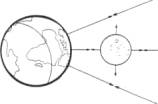 Fig.81 Fig.81
*
The motion which we get to see because of inertia
corresponds usually with a transmission of force within the body, often
only at the speed of sound, though – this can differ depending on the
material.
|