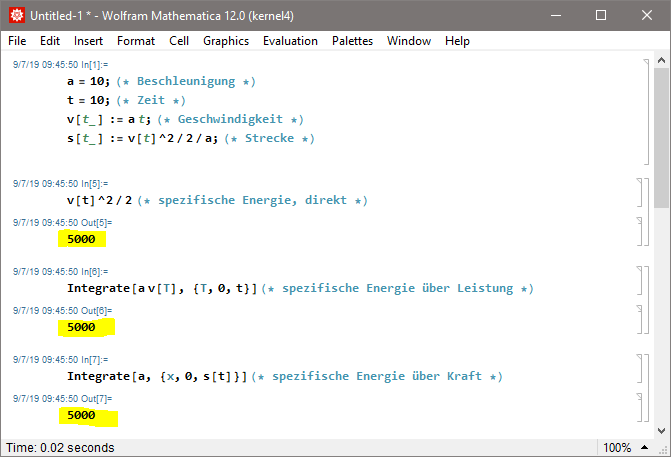
Hier ist ein schönes Beispiel.

where
P = power
F = force
d = distance
t = time
To understand what these definitions mean, let's consider a simple example. Say you had to move a heavy desk 10 ft (3 m) from one side of the room to another. You push on the desk with a force of 90 lb (400 N), but the desk doesn't budge. In this case, a force has been applied, but since the desk remains in the same place, you didn't perform any work. Now you ask a friend to help you, and he pushes on the desk with the same force as you. Your combined force of 180 lb (800 N) allows you to move the desk to its new location in half a minute (30 seconds).
Based on the above equation, the power you and your friend generated to perform that work was 60 foot-pounds per second or 80 newton-meters per second. In the Metric system, the unit of a watt (W) is defined as a newton-meter per second, so the power it took to move the desk is 80 W or 0.08 kW. The English system equivalent of a watt is horsepower, and 1 hp is defined as being equal to 550 ft-lb/s. In other words, our 60 ft-lb/s is equivalent to 0.11 hp. In this case and this case only, we can say that a force of 180 lb converts to 0.11 hp. As we have seen, however, that conversion depends on the variables distance and time. If you and your friend used the same force to move the desk the same distance but it took only 15 seconds, the power would double to 0.22 hp (0.16 kW).

 Anmelden
 Registrieren
 FAQ
 Suche