Im Laborsystem breitet sich das Licht ohne Dopplereffekt aus. Im gestrichen System ergibt sich ein Dopplereffekt. Das bedeutet, dass gemäß SRT zwei relativ bewegte Beobachter die Ausbreitung des Lichtes unterschiedlich wahrnehmen.
Ein im Laborsystem ruhender Beobachter wird sagen: Die drei Lichtblitze breiten sich in Form konzentrischer Sphären aus, während ein im gestrichenen System ruhender Beobachter sagen wird: Die (selben) drei Lichtblitze breiten sich in Form nicht-konzentrischer Sphären aus.
Das liegt daran, dass der eine Beobachter gegenüber dem Blitzgerät ruht und der andere nicht.
Vorraussetzung für die SRT sind aber nun die beiden Postulate:
- Relativität (d.h. Beobachterunabhängigkeit) der Lichtausbreitung.
- Konstanz und Isotropie der Lichtausbreitung. D.h. ein Beobachter ruht stets relativ zum Zentrum der sphärischen Lichtausbreitung.
Beide Postulate ergeben gemeinsam:
- Jeder Beobachter ruht stets relativ zum Zentrum der sphärischen Lichtausbreitung.
Wie die Animation unten zeigt, steht laut SRT nicht jeder Beobachter stets im Zentrum der sphärischen Lichtausbreitung. Die Animation zeigt also, dass die SRT mit der Lorentztransformation nicht die beiden Postulate erfüllt.
Gesegnete Weihnacht
Faber
Dateianhang:
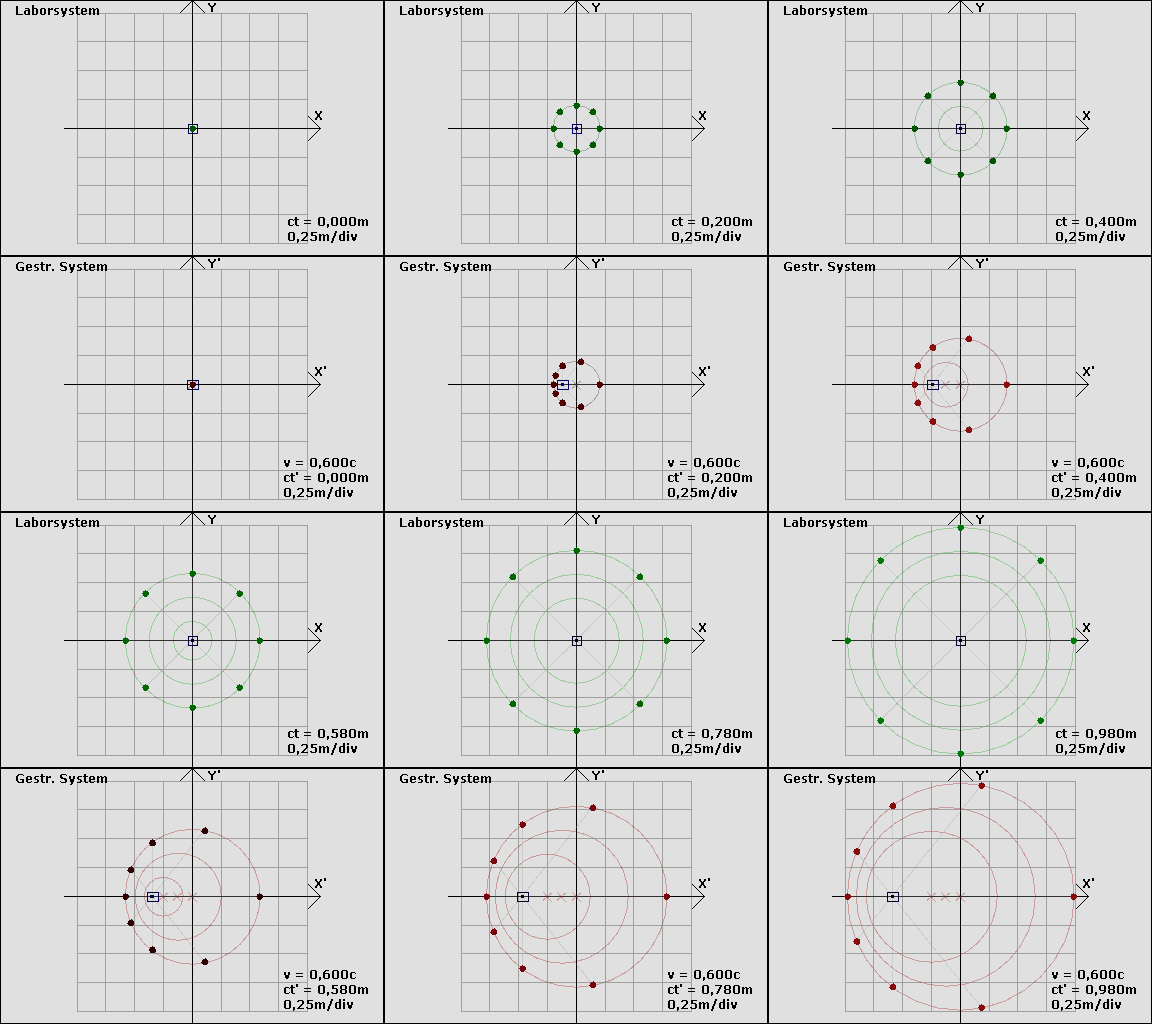 LightSphere-c600.gif [ 502.52 KiB | 6024-mal betrachtet ]
LightSphere.java (V1.4):
Code:
import java.awt.AlphaComposite;
import java.awt.BasicStroke;
import java.awt.Color;
import java.awt.Composite;
import java.awt.Font;
import java.awt.Graphics2D;
import java.awt.geom.AffineTransform;
import java.awt.geom.Ellipse2D;
import java.awt.geom.Line2D;
import java.awt.geom.Rectangle2D;
import java.awt.image.BufferedImage;
/**
* Erstellt eine GIF-Datei.
* <p>
* Das animierte Bild zeigt die Ausbreitung eines Lichtblitzes in Form einer Lichtsphäre vom
* Ursprung eines Laborsystems aus sowie die Ausbreitung desselben Lichtblitzes in bezug auf ein zum
* Laborsystem relativ bewegtes, gestrichenes System.
* </p>
* <p>
* Man rufe die {@link #main(String...)}-Methode auf.
* </p>
*
* @author Faber
* @version 1.4
*/
public class LightSphere
{
/** Breite des Bildes in Pixeln. */
private final int w = 256 + 128;
/** Höhe des Bildes in Pixeln. */
private final int h = 512;
/** Lichtgeschwindigkeit in m/s. */
private final double c = 300E6;
/** Relative Schnelligkeit der Bezugssysteme. */
private final double v = 0.600 * c;
/** Gamma-Faktor der Lorentztransformation. */
private final double gamma = 1.0 / Math.sqrt(1 - (v * v) / (c * c));
/** Zeit zwischen zwei Blitzen. */
private final double T = 0.125 / v;
/**
* Erstellt die Bilddatei.
*
* @see #main(String...)
*/
private LightSphere()
{
final String sv = String.format("%.3f", v / c).substring(2);
final String fileName = String.format("%s-c%s.gif", LightSphere.class.getSimpleName(), sv);
final AnimatedGifEncoder gifenc = new AnimatedGifEncoder();
gifenc.setQuality(10);
gifenc.setRepeat(0);
gifenc.setDelay(100);
gifenc.start(fileName);
final double t0 = 0; // Startzeitpunkt in Sekunden
final double t1 = 1 / c; // Endzeitpunkt in Sekunden
final double dt = (t1 - t0) / 50;
for (double t = t0; t <= t1; t += dt)
{
final BufferedImage image = new BufferedImage(w, h, BufferedImage.TYPE_3BYTE_BGR);
final Graphics2D graphics2D = image.createGraphics();
try
{
{ // Hintergrund
graphics2D.setColor(new Color(0xE0E0E0));
graphics2D.fillRect(0, 0, w, h);
}
{ // Bilder
paint(graphics2D, t, true);
paint(graphics2D, t, false);
}
}
finally
{
graphics2D.dispose();
}
gifenc.addFrame(image);
}
gifenc.finish();
}
/**
* Malt ein Phasenbild der Animation.
*
* @param graphics2D
* Grafik-Kontext.
* @param t
* Zeitpunkt in Sekunden.
* @param labor
* Zeigt an, ob in bezug auf das Laborsystem gemalt wird.
*/
private void paint(final Graphics2D graphics2D, final double t, final boolean labor)
{
final Color blue = new Color(0x0000A0);
final Color gray = new Color(0xA0A0A0);
final int R = h / 4;
final int mx = 3 * R / 2;
final int my = labor ? R : 3 * R;
final double scale = 0.9 * R;
final double u = 1.0 / scale; // gibt die Breite eines Pixels in Metern an
final double meterPerDiv = 0.25;
final AffineTransform transform = new AffineTransform();
transform.translate(mx, my);
transform.scale(scale, scale);
final AffineTransform originalTransform = graphics2D.getTransform();
try
{
graphics2D.setTransform(transform);
graphics2D.setStroke(new BasicStroke((float) u));
{ // Gitter malen
graphics2D.setColor(gray);
for (double x = -1.0; x <= 1.0; x += meterPerDiv)
{
graphics2D.draw(new Line2D.Double(x, -1, x, 1));
}
for (double y = -1.0; y <= 1.0; y += meterPerDiv)
{
graphics2D.draw(new Line2D.Double(-1, y, 1, y));
}
}
}
finally
{
graphics2D.setTransform(originalTransform);
}
{ // Achsen und Text malen.
final int d = 12;
graphics2D.setColor(Color.BLACK);
graphics2D.setStroke(new BasicStroke());
graphics2D.draw(new Line2D.Double(mx + R, my, mx - R, my));
graphics2D.draw(new Line2D.Double(mx + R - d, my + d, mx + R, my));
graphics2D.draw(new Line2D.Double(mx + R - d, my - d, mx + R, my));
graphics2D.draw(new Line2D.Double(mx, my + R, mx, my - R));
graphics2D.draw(new Line2D.Double(mx - d, my - R + d, mx, my - R));
graphics2D.draw(new Line2D.Double(mx + d, my - R + d, mx, my - R));
graphics2D.drawRect(0, my - R, w - 1, 2 * R - 1);
final Font font = new Font("Verdana", Font.BOLD, 12);
final String text = String.format("%s = %.3fm\n", labor ? "ct" : "ct'", c * t);
final Rectangle2D r = font.getStringBounds(text, graphics2D.getFontRenderContext());
final int th = (int) (r.getHeight() + 0.5);
final int tw = (int) (r.getWidth() + 0.5);
graphics2D.setFont(font);
graphics2D.drawString(String.format("%.2fm/div", meterPerDiv), w - tw - th, my + R - th);
graphics2D.drawString(text, w - tw - th, my + R - 2 * th);
if (!labor)
{
graphics2D.drawString(String.format("v = %.3fc", v / c), w - tw - th, my + R - 3 * th);
}
graphics2D.drawString(labor ? "Laborsystem" : "Gestr. System", th, my - R + th);
graphics2D.drawString(labor ? "X" : "X'", (int) (mx + scale + 0.5 * th),
(int) (my - 0.5 * th));
graphics2D.drawString(labor ? "Y" : "Y'", (int) (mx + 1.0 * th),
(int) (my - scale - 0.0 * th));
}
try
{
graphics2D.setTransform(transform);
graphics2D.setStroke(new BasicStroke((float) u));
final Color color = labor ? new Color(0x00A000) : new Color(0xA00000);
final double xBlitz = labor ? 0 : -v * t;
final double yBlitz = 0;
final int noOfPhotons = 8;
final double[] xPhoton = new double[noOfPhotons];
final double[] yPhoton = new double[noOfPhotons];
{ // Photonen berechnen
for (int k = 0; k < noOfPhotons; k++)
{
final double alpha = 2 * Math.PI * k / noOfPhotons;
xPhoton[k] = labor ? xLabor(alpha, t) : xStrich(alpha, t);
yPhoton[k] = labor ? yLabor(alpha, t) : yStrich(alpha, t);
}
}
{ // Kreise malen.
final double x1 = 0;
final double y1 = 0;
final double r1 = c * t;
final double x2 = labor ? 0 : -v * T;
final double y2 = 0;
final double r2 = c * (t - T);
final double x3 = labor ? 0 : -v * 2 * T;
final double y3 = 0;
final double r3 = c * (t - 2 * T);
final Composite originalComposite = graphics2D.getComposite();
try
{
graphics2D.setComposite(AlphaComposite.getInstance(AlphaComposite.SRC_OVER, 0.3f));
graphics2D.setColor(color);
graphics2D.draw(new Ellipse2D.Double(x1 - r1, y1 - r1, 2 * r1 + u, 2 * r1 + u));
final double d = 4 * u;
if (!labor)
{
graphics2D.draw(new Line2D.Double(x1 - d, y1 - d, x1 + d, y1 + d + u));
graphics2D.draw(new Line2D.Double(x1 - d, y1 + d, x1 + d, y1 - d + u));
}
if (t >= T)
{
graphics2D.draw(new Ellipse2D.Double(x2 - r2, y2 - r2, 2 * r2 + u, 2 * r2 + u));
if (!labor)
{
graphics2D.draw(new Line2D.Double(x2 - d, y2 - d, x2 + d, y2 + d + u));
graphics2D.draw(new Line2D.Double(x2 - d, y2 + d, x2 + d, y2 - d + u));
}
if (t >= 2 * T)
{
graphics2D
.draw(new Ellipse2D.Double(x3 - r3, y3 - r3, 2 * r3 + u, 2 * r3 + u));
if (!labor)
{
graphics2D.draw(new Line2D.Double(x3 - d, y3 - d, x3 + d, y3 + d + u));
graphics2D.draw(new Line2D.Double(x3 - d, y3 + d, x3 + d, y3 - d + u));
}
}
}
}
finally
{
graphics2D.setComposite(originalComposite);
}
}
{ // Verbindungslinien Blitzgerät-Photonen malen.
final Composite originalComposite = graphics2D.getComposite();
try
{
graphics2D.setComposite(AlphaComposite.getInstance(AlphaComposite.SRC_OVER, 0.3f));
for (int k = 0, N = 8; k < N; k++)
{
final double x = xPhoton[k];
final double y = yPhoton[k];
{
graphics2D.setColor(gray);
graphics2D.draw(new Line2D.Double(x, y, xBlitz, yBlitz));
}
}
}
finally
{
graphics2D.setComposite(originalComposite);
}
}
{ // Blitzgerät malen.
final double x = xBlitz;
final double y = yBlitz;
{
final double ry = 4 / scale;
final double rx = labor ? ry : ry * gamma;
graphics2D.setColor(blue);
graphics2D.draw(new Rectangle2D.Double(x - rx, y - ry, 2 * rx + u, 2 * ry + u));
}
{
final double ry = 1 / scale;
final double rx = labor ? ry : ry * gamma;
graphics2D.setColor(blue);
graphics2D.fill(new Rectangle2D.Double(x - rx, y - ry, 2 * rx + u, 2 * ry + u));
}
}
{ // Photonen malen.
for (int k = 0, N = 8; k < N; k++)
{
final double x1 = xPhoton[k];
final double y1 = yPhoton[k];
{
final double r = 3 / scale;
graphics2D.setColor(color);
graphics2D.fill(new Ellipse2D.Double(x1 - r, y1 - r, 2 * r + u, 2 * r + u));
}
}
}
}
finally
{
graphics2D.setTransform(originalTransform);
}
}
/**
* Liefert die x-Komponente der Trajektorie eines Photons.
*
* @param alpha
* Richtung, in die das Photon im Laborsystem vom Ursprung aus fliegt, in Radian.
* @param t
* Zeitpunkt t im Laborsystem, in Sekunden.
* @return die x-Position des Photons zum Zeitpunkt t in Metern.
*/
public double xLabor(final double alpha, final double t)
{
return c * t * Math.cos(alpha);
}
/**
* Liefert die y-Komponente der Trajektorie eines Photons.
*
* @param alpha
* Richtung, in die das Photon im Laborsystem vom Ursprung aus fliegt, in Radian.
* @param t
* Zeitpunkt t im Laborsystem, in Sekunden.
* @return die y-Position des Photons zum Zeitpunkt t in Metern.
*/
public double yLabor(final double alpha, final double t)
{
return c * t * Math.sin(alpha);
}
/**
* Liefert die x'-Komponente der Trajektorie eines Photons.
* <p>
* Herleitung siehe <a href="http://www.mahag.com/neufor/viewtopic.php?p=20494#p20494">hier</a>.
* </p>
*
* @param alpha
* Richtung, in die das Photon im Laborsystem vom Ursprung aus fliegt, in Radian.
* @param tStrich
* Zeitpunkt t' im gestrichenen System, in Sekunden.
* @return die x'-Position des Photons zum Zeitpunkt t' in Metern.
*/
public double xStrich(final double alpha, final double tStrich)
{
final double denominator = (c - v * Math.cos(alpha));
return c * tStrich * (c * Math.cos(alpha) - v) / denominator;
}
/**
* Liefert die y'-Komponente der Trajektorie eines Photons.
* <p>
* Herleitung siehe <a href="http://www.mahag.com/neufor/viewtopic.php?p=20494#p20494">hier</a>.
* </p>
*
* @param alpha
* Richtung, in die das Photon im Laborsystem vom Ursprung aus fliegt, in Radian.
* @param tStrich
* Zeitpunkt t' im gestrichenen System, in Sekunden.
* @return die y'-Position des Photons zum Zeitpunkt t' in Metern.
*/
public double yStrich(final double alpha, final double tStrich)
{
final double denominator = (c - v * Math.cos(alpha)) * gamma;
return c * tStrich * (c * Math.sin(alpha)) / denominator;
}
/**
* Programmeinstiegspunkt.
*
* @param args
* wird ignoriert.
*/
public static void main(final String... args)
{
new LightSphere();
}
}

 Anmelden
 Registrieren
 FAQ
 Suche