|
Why
does the universe exist? Why is there not just a nothingness in its
stead?
In order to answer this
question we have to examine the concept of “nothingness” a little
closer. We created it by ourselves on the basis of our experience. This
experience was born of the fact that objects exist in a given space and
that they can be removed. But even when we remove, for example, all
objects from a room, this does not mean that a nothingness is left
because we have a definition for that what remains: air. When we remove
the air, we oddly enough do not speak of a nothingness but characterise
the new condition with one word that expresses especially the lack of
air: vacuum. Well, we could also remove the whole room together with its
vacuum; in addition, we could try to imagine the nothingness by removing
the Earth, the sun, the galaxies, and the cosmos. Then we will maybe see
an empty space but we are still bodily within this space and torment
ourselves with the difficult mental image of the nothingness. Maybe we
should remove ourselves as well - but who would then define the
nothingness as such?
The nothingness is
therefore not only unimaginable but absolutely impossible without a
something that marks the boundaries - just like a hole which is
inconceivable without its surroundings. We can only relate the term
nothingness to the absence of defined objects. However, an absence of
objects can only be possible if these objects exist in some way
somewhere.
Obviously
without giving it a thought, we know and use a word for a condition that
cannot exist at all and pose an absolutely unnecessary question using
this word. If there cannot be such a thing as an absolute nothingness,
we are automatically forced to assume the opposite: existence: For that
reason, it is quite comprehensible that “something” exists - but of
course it does not go without saying that this something must have
adopted the form of our universe of all things.
Anyhow,
this first little discovery that there has to be at least something
takes away the question where this something comes from. We cannot just
remove the cosmos, because where should we put it? But if this is the
case it was never brought into its place, because where would it have
been before?
There
has to be just something from a logical point of view... A simple matter
remains to be answered: how does this something manage to become the
universe as we know it? Our simple train of thought forces us
immediately to conclude that this something as an undefined, shapeless
existence is actually timeless, i.e. it exists eternally. Neither
“before” nor “after” is it possible that a nothingness exists.
The
ancient Chinese had an equivalent for this shapeless, featureless
existence which they called Tao. Tao is the unity, the cause behind the
things we perceive. Buddhists often compared this Tao to a completely
calm lake whose smooth surface reflected nothing. This is a good
comparison which we will use as well. We will call our basic structure,
the matrix, “The Absolute Organization“, using the abbreviation
T.A.O. to express the shapeless existence. This shapelessness is
relative; even if T.A.O is not just an object it has to be of a certain
condition. We have to imagine this condition vividly in order to detect
the cause of all apparent laws of nature in it. Although an ambitious
goal it is not too difficult to put into practise. We will only be
credible if we are prepared to accept as facts the phenomena made
irrefutable by the discoveries of science.
We will try to describe
T.A.O., the Indefinable, and in doing so we will set up a fiction. But
this, the only admissible fiction, only serves for better comprehending
the function of T.A.O. as an energy relay and carrier of information.
Any further fiction is forbidden to us.
All phenomena described in the following have already been treated and
described by science - although without recognising their origin and
their cause.
Well, T.A.O., the shapeless existence, does not look like
anything because there is no eye to see it. Nevertheless, T.A.O. must
have a recognisable structure in order to be distinguished from the
nothingness. When researching this structure we have to look for the
simplest thing that can be thought of.
It has to be just a little bit more than
nothing to be sufficient.
Just like the smooth surface of a lake has a structure, namely the
spread of water molecules which do not reflect anything yet, T.A.O. must
also have a structure, at least in form of a subdivision into separate
units. It doesn’t matter particularly if these units can be subdivided
for certain or not. Let’s just say this simple structure consists at
least of points which lie next to or on top of each other as if the
space was filled with an infinite amount of tiny spheres which keep in a
regular order like the atoms of a crystal. Just think of the inside of the lake and its molecules and you
will get a similar picture.
Naturally,
even this structure has a cause which we will comprehend automatically
later-on. For the time being, we want to be satisfied with this
definition of T.A.O. as an arrangement of rather insubstantial and
impassive points. Instead of T.A.O. we could also use some other word
like “Matrix” or just “Space”.
The physicist Mach already had the idea that the apparently empty space had to be actually granular somehow. The Pakistani physicist
Abdus Salam expressed a similar thought more recently. We are thus in good company. Even if our matrix differs from the “obsolete” ether theories, the basic thought is absolutely comparative.
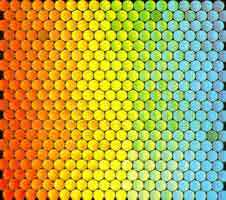
When we mentally enlarge this structure enormously, we will approximately get an image as shown in figure 1.
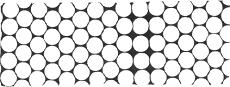 Fig.1
Fig.1 Fig.2 Fig.2
A simple, motionless structure of points or little granules which are pressed together as close as possible. It continues three-dimensionally in all directions (fig. 3a). It doesn’t have a size as long as there is not any scale in it. It has no beginning and no end because it exists eternally out of necessity. Neither is there time in the conventional sense because there aren’t any events or any clocks to measure it. The nature of T.A.O. is therefore endless, timeless, eventless, without size, without scale - and yet of a granular structure which is supposedly at rest for the time being - leaving it open whether this condition is possible at all.
Anyhow, we want to draw one conclusion from what we just said: the space in which the universe takes place is not and never has been
empty!
Well, the just described structure of T.A.O. is on no account pure fiction. Something exists and this something is at least an energetic condition; an accumulation of such conditions, to be exact. We could say: close to every something another something exists and so on... We can discover and understand the natural tendency towards structures of this simple kind by experimenting with, so to speak, flowing energies, for example with heat. A liquid heated from below produces convection cells. Figure 2 shows such a process, and we see immediately the principal similarity with figure 1:
The matter becomes even clearer when we make the thermal structures visible by means of the electric impulse photography developed by Dennis Milner und Edward Smart. Gleaming thermal spheres appear on a photographic plate which is subjected to an electric impulse between two metal electrodes. They demonstrate that energy does not just flow or disperse but structures itself into certain orders. These are called dissipative structures, and we will come back to them later. But now let’s take a look at the thermal spheres on the photographic plate (figure 3):
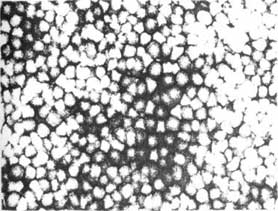 Fig.3 Fig.3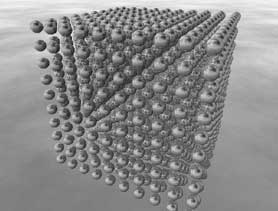 Fig.3a Fig.3a
At this point, we also see nothing but an enormous magnification of the structure of T.A.O.. Well, we cannot attach a certain size to T.A.O. itself but the events above give us an approximate impression of the dimensions in which we are roaming mentally. Atomic manifestations take place on a scale for which we invented the unit Angstrom. One Angstrom is inconceivably small, it is 1/10 000 000 mm. If we extended one millimetre until it covered the distance from one pole of the earth to the equator, which are ca. 10 000 km, one Angstrom would have become just one meter long. Well, one glucose molecule already measures about five Angstrom, and there is a distance of one Angstrom between its atoms. Molecules and atoms, however, are already gigantic objects compared to the structure of T.A.O. Therefore we can only enter these areas mentally; there wouldn’t be any devices to measure these dimensions in any way.
(Link zur Abbildung "Größenverhältnisse im
Universum").
Properly speaking we have to admit that this structured T.A.O. represents neither an existence nor a nothingness. It forms the basis for both terms. Something exists and yet it does not exist as long as it is not perceived. The nothingness and the existence, both mean absolutely the same. The image of this world is a process of looking at it. It does not exist without the eyes. T.A.O. is neither dark nor light, neither hot nor cold... Whatever we are looking for, we will only find structure and substructure. If all these structures were at rest in themselves there would be no universe. No universe... that doesn’t mean on any account, however, the nothingness. Because the structure still exists.
Of all the numerous theories based on the ether, the lattice model by Walter Russell and John Worrell Keely (“The space is filled with a motionless flexible lattice!“) is the one which is the most similar to our concept. Yet the lattice model is not logical and self-explaining but a forced design. Where should the lattice come from? The basic structure of the universe must be an inevitable, casual phenomenon, a basic order which is neutral in itself and yet must have the absolute property to carry the prerequisites and processes from which the phenomena and quantities we know, like charges, quanta, light, material mass, or inertia, can or rather must develop independently. We will see that if anything fulfils this expectation, it is the matrix of T.A.O..
Of course, we must certainly not mark this T.A.O. as primordial matter. It is not a material substance, it does not “consist” of something but it takes place, it has an effect... In our language, we have a word for something that has an effect: energy. Therefore, what we have found up to now is space - structured space - in which energy can have an effect. Nothing more. Whatever forms the basis of this effect can always be given any name one likes. We just call it T.A.O.. It is a simple, short word and contains a certain beauty. Already the Chinese choose it for this reason.
siehe auch Extrabeitrag "T.A.O. - Matrix und
der Unterschied zum Äther"! |