|
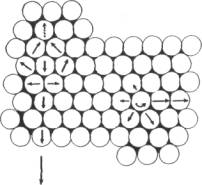
When we disturb T.A.O. or when it is disturbed in some way, in fact something similar to the events on a surface of water will take place but in all directions of the space at the same time, i.e. three-dimensionally. So disturbance can change T.A.O. and enrich it with information. Though not any random form of disturbance is possible but certainly only that which casually results from the structure of T.A.O. The simplest kind of disturbance is an impulse moving through T.A.O. For this impulse we will also use the term shove or vibration. The form of this impulse is shown in some detail in figure 4:
On the left side of the figure we can see how a vibration - the impulse moves downwards - reacts back on itself, i.e. it is also transmitted in the opposite direction through the shifting of the granules. As a consequence, everything is at rest again after the shove. Therefore not an oscillation is moving through this matrix but a tremor. Later, we will substantiate in detail why there cannot be any oscillations within T.A.O.
Every granule transmits the disturbance to the next one but not immediately. It will take a short time until the next granule becomes aware of the impulse. There are no instantaneous causalities, a little time will always elapse between cause and effect. For that reason, time is already a product in this structure, the interval stands always between cause and effect first and foremost. In a simple way we thus discovered time within T.A.O.; and what we said about T.A.O. also applies to time: as long as no-one perceives and measures and above all interprets an interval between past and future, time in the conventional sense does not exist. Still it has an effect… Since we already talked about energy, in time we find a second important factor for the existence of the
universe.
On the right side of the figure, we see an impulse coming towards us, from the front of the structure so to speak. Every disturbance of a granule is of course also transmitted to all granules which are arranged perpendicularly to the movement of the impulse. If the disturbance is a torsional vibration, the transmission cannot take place simultaneously but only in such a way that the impulse is surrounded by further disturbances in its direction of movement so to speak. We can define this form of impulse more exactly by simply saying: a disturbance spirals through the structure of T.A.O. Starting from an arbitrary point it seizes all other points of T.A.O. and therefore has a discernible direction of movement because the ancillary shoves caused by the main shove follow temporally behind. Since the individual granules always oscillate or vibrate only around their own area, there isn’t any real movement in T.A.O. The transmitted impulse is only information passed-on. The content of this information - that is to say form and extent of the disturbance - maybe means “energy” for a possible recipient which uses a language like we do - and actually he could already call it “light”… But one thing after the other!
Since every disturbance is equalised retroactively of its own accord - the granules are pressed back into their close-grained, dense texture - there will always be only one single disturbance or vibration running through the structure while everything becomes smooth and at rest again behind it. And we see a considerable difference to the allegory of the lake: an impulse does not cause a real wave! Just to emphasise it again: everything is at rest before and after the impulse.
When we dip our finger into a lake for a moment we generate a series of waves which spread in circles. Very metaphorically speaking, if we dipped our finger into T.A.O. for a moment, the result would be a single shove (and only one “circle”) spiralling through T.A.O. It consists of two different movements: the forward movement and the perpendicular radiation of further shoves. Both components are shown in figure 5. This relay of impulses results automatically from the nature of the structure. The form of the applied impulse is significant. When we make a granule vibrate, the radiating shoves will be equally intensive in all directions; when we make the granule move only into a vertical or horizontal direction, the impulse passed on to the granules which do not lie in this direction will be weaker. In that way, we polarised the impulse so to speak.
 Fig.5
Fig.5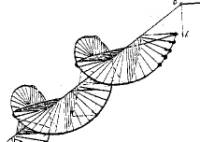
Hopefully, it was not too difficult to understand the above. Despite its simplicity this function of T.A.O. is already something like the key to the universe!
We
could also symbolise the form of the impulse by drawing a spiral1 (figure
6). After all, it includes both directions of movement! Mankind has
always recognised the symbolic meaning of the spiral[i]
intuitively. Particularly in the Eastern religions it plays a
significant role. As we saw, not completely without
reason. But in T.A.O., there are only spiral paths - no
stationary spirals.
 Fig.6 Fig.6 Fig.6a Fig.6a
When we disturb T.A.O. once - figure 6a, a) - and then a second time, a second shove will follow the first one without being in direct connection with it. Neither would a third one have anything to do with the previous ones – figure 6a, b). Frequency is the name we give to a succession of several impulses in the same direction within a certain time. The intervals between one shove and the next is called wavelength without signifying a real wave. For linguistic reasons, however, we will continue using the term wave because we are now aware of the little but significant difference.
When we designate one directional plane of the impulse as the “electric” one and the one perpendicular to it as the “magnetic” one, we will get a good expression for the sequence of several impulses: “electromagnetic wave“. Well, this term is already in use, and of course, the process in T.A.O., as we just described it, is in principle nothing but an electromagnetic wave as symbolically shown in figure 5a. But the designations “electric” and “magnetic” don’t have any special meaning for us
yet.
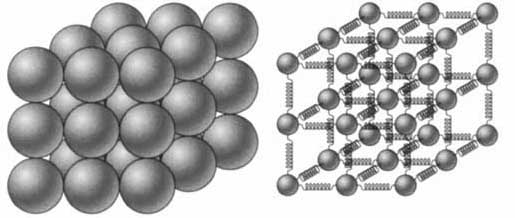
If we wanted to build a model of T.A.O., we would have to put some fairly elastic spheres in layers one on top of each other and eliminate friction. There isn’t any friction in T.A.O. The physicist would say that it was a matter of elastic shoving actions which didn’t consume any energy. In such cases, he speaks therefore of the conservation of the impulse. But we must not imagine the granules of T.A.O. to be anything but vibrating about themselves as if they were connected by springs (fig. 6b).
To put it in a nutshell: The structure of T.A.O. can be disturbed by an impulse which is continued on two directional planes. The sussession of several such shoves is not a wave as it may spread for example in material media (sound or gravity waves) because the impulses are not connected to each other in any way. Every serious analogy with oscillations or waves would be wrong. Later, we will see that many physicists drew a couple of wrong conclusions because of this incorrect analogy...
When the message transported by the quickly running individual shove is energy, we could also call it “energy quantum”. This fact is done justice to by the quantum theory of physics which already acknowledges that all energies are transmitted in form of small portions, i.e. quanta. That this is not just a whim of nature but that it is not possible in any other way is what we just found out.
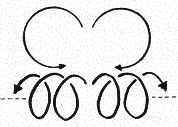 Fig.7 Fig.7 Fig.7a
EM-WAVE Fig.7a
EM-WAVE
In our hypothesis, we could of course also stimulate a granule in the centre of T.A.O to start oscillating or rotating or we could give it a shove (which would be the more correct way of looking at things). As a consequence, one impulse would run to the right and one to the left. And we would also discover that one impulse began spiralling to the right and the other to the left starting from the point of generation (figure 7).
Hence there are two spiral paths with different spatial orientation. With this trivial insight we are already in a position to describe the material events in this universe entirely, as strange as this may sound at this point. But all discoveries which are necessary to be made in the following are a direct result of this spatially different orientation of impulses. With the spatial condition we come across the third important factor of these few elementary basic concepts which are responsible for the existence of the world: space. The other two are: energy and time. All three concepts are the result of each other because if there were not any intervals between cause and effect, a spatially defined order would not be
possible.
We should now think a little about what has been demonstrated so far in order to comprehend the connection between energy, space, and time intuitively. All concepts are based on T.A.O.– because T.A.O. is, as we will see, the carrier of energy, space, and time. All three concepts are effects, and as we will learn later, they only exist due to perception or “measurement” as the physicist would state it more precisely.
Actually, with these three elementary effects we already found everything that is to be found in this
cosmos!
|
|
1
Nature does not know any straight paths.
Wherever something grows or moves a spiral is the final result. Since
Galileo and Newton, the physicists have put in our heads: that the most
natural form of movement is the uniform progressive motion in a straight
line. But in truth everything in nature deviates from the straight line
and moves in the form of spirals. Everything in nature expands or flows
- from inorganic crystals to animated beings up to star clusters and
galaxies. But almost nothing grows or flows uniformly. Let’s imagine
something is rising like a tree –
the trunk of a plant, the calcium carbonate skeleton of a mussel, which
grows vertically upwards, or the stream of gas exhausted by a star. As
long as there are no disturbances, the cohesive mass – cells or gas
molecules – fills the space uniformly forming
a hose. But as soon as one side is growing faster (because
more energy is flowing there) or slower (due to friction) than
the other, the hose will bend to one side - in fact the stronger, the
more it grows or the more it is retarded. A spiral will finally
originate from the bend.
Moss
from STS–87, showing spiral growth patterns developed in the dark in
microgravity.
http://weboflife.nasa.gov/currentResearch/currentResearchFlight/sts107SeekingTheLight.htm
 
The
solder, heated, became a molten blob with a droplet of rosin clinging
tight to the outside. Solder melts: that's not too surprising. It's the
behavior of the rosin that amazed. As the temperature increased, the
droplet began to spin, round and round, faster and faster, like a
miniature carnival ride.

http://science.nasa.gov/headlines/y2004/16aug_solder.htm?list610324
|